The European Association of Innovation Consultants (EAIC) released a position paper on the Future of the EU Multiannual Financial Framework 2028–2034. The next EU’s long-term spending plan will introduce a restructured funding architecture including the next Research and Innovation Framework Programme (FP10), the European Competitiveness Fund (ECF) and the National and Regional Partnership Plans (NRPPs).
FI Group plays an active role within the EAIC through its representation on the EAIC Board and its coordination of thematic work. In particular, Victor Cruz, Public Affairs, Regulatory and Strategy Director at Fi-Group, serves as a member of the EAIC Board, while Luca Pira coordinates the Working Group on national funding schemes, which contributed directly to the drafting of the position paper.
The association supports the overall ambition to strengthen Europe’s competitiveness, strategic autonomy and territorial cohesion through a more integrated approach to research, innovation and deployment.
It highlights the intention to create a more integrated policy framework linking research, innovation, industrial deployment and regional development, while underlining that the effectiveness of this approach will depend on clear governance, predictable programming and sufficient budgetary resources.
Regarding FP10, EAIC notes the proposed financial envelope of €175 billion in current prices and reiterates its view that this level should be regarded as a minimum. The Association recalls its recommendation for a budget of at least €200 billion (2025 prices), with collaborative research under Pillar II remaining the central component of the programme. The paper also draws attention to implementation aspects, including programme predictability, evaluation procedures, the use of lump‑sum funding and the operational clarity of research security provisions.
In its assessment of the European Competitiveness Fund, EAIC recognises the rationale for a dedicated instrument supporting strategic technologies and industrial deployment. At the same time, the position paper identifies a need for clearer definitions of award criteria, funding modalities and co‑financing requirements, as well as transparent governance arrangements. Particular emphasis is placed on maintaining accessibility for SMEs and ensuring a clear interface between FP10 and the ECF.
The position paper also addresses the proposed National and Regional Partnership Plans, expressing concerns about the limited role currently envisaged for regional authorities. EAIC stresses the importance of multi‑level governance, distinct financial envelopes and
stronger territorial indicators to preserve the place‑based character of cohesion‑related investments.
The EAIC position paper reflects the collective practical experience of its members in the preparation and implementation of EU‑funded research and innovation projects across Member States. Within this context, FI Group is closely monitoring developments and preparing to support clients.
Get in touch to learn more about how these changes may affect your funding strategy.
That mindset is changing rapidly. The average global cost of a data breach reached USD 4.88 million in 2024, marking a significant year‑on‑year increase and highlighting the severe financial and reputational consequences of inadequate protection. But the true cost goes far beyond fines and incident response. Recent research shows that 87% of consumers would not do business with a company if they had concerns about its security practices or recent security and privacy incidents. This convergence of escalating risk and eroding trust demands a fundamental rethink.
The question is no longer:
How can we meet minimum compliance requirements?The strategic imperative today is:
How can we transform investment in robust privacy and cutting‑edge cybersecurity into a measurable competitive advantage that drives sustainable business growth?
At FI Group, we see this as the dawn of the Trust Economy. Compliance is the floor; trust is the ceiling. This article explores why a proactive, globally aware approach to privacy and security—one that goes beyond compliance—is the single most critical investment for securing your future, enhancing market positioning, and unlocking new revenue streams.
The rise of cyber threats, from ransomware‑as‑a‑service to state‑sponsored espionage, requires a strategic shift. Every amount spent on advanced security and privacy is not a tax on innovation but an investment in resilience and market leadership.
In a hyper‑connected world, business continuity depends on cyber resilience. The ROI of cybersecurity is best measured by revenue protected, intellectual property secured, and operational efficiency gained.
Time is the most expensive variable in a cyber incident. The global average lifecycle for a data breach is 277 days. Longer lifecycles mean higher costs. Conversely, rapid and sophisticated incident response translates into significant savings.
Companies leveraging AI and automation in Security Operations Centres (SOCs) save an average of USD 2 million compared to those without. This is not just a technology purchase; it involves developing and integrating automated detection and response algorithms—activities that often qualify for R&D tax credits globally.
More than 60% of cyberattacks originate via supply chains or third‑party vendors, making supply chain resilience a critical responsibility.
Certifiable cybersecurity is becoming the new standard for B2B engagement.
The fragmentation of data protection laws, from GDPR to emerging US state and APAC regulations, demands a globally consistent “Gold Standard” in privacy governance.
Consumer trust is fragile. Around 34% of consumers globally will abandon a brand if their data is misused, making privacy a direct revenue driver.
Privacy regulation is not a constraint; it is a catalyst for innovation. Privacy by Design principles encourage solutions that extract analytical value while minimising exposure.
Developing and integrating these solutions often qualifies as technological R&D, making them eligible for global innovation incentives.
At FI Group, we help multinationals adopt a Beyond Compliance posture while minimising net costs through R&D tax credits, grants, and innovation incentives.
| Project Activity | Technical Challenge | Eligible for R&D Funding? |
|---|---|---|
| Developing ZTA | Creating proprietary policy engines for continuous authentication | Yes |
| Data Anonymisation | Novel algorithms for GDPR‑compliant differential privacy | Yes |
| Next‑Gen Threat Detection | Training ML models for advanced persistent threats | Yes |
| Post‑Quantum Cryptography | Researching new cryptographic protocols | Yes |
| Routine Patching | Applying standard updates | No |
Organisations face a choice: treat privacy and cybersecurity as costly compliance exercises or embrace them as growth drivers and trust builders.
The businesses that dominate the next decade will be the most trusted.
By adopting a Beyond Compliance mindset and funding innovation through R&D incentives, companies secure more than networks—they secure market leadership.
Implementing a global Beyond Compliance strategy requires technical, financial, and regulatory expertise. FI Group offers a unified global service to align security investment with maximum innovation incentives.
Data privacy is the principle that allows an individual to have control over their personal data, including the ability to decide how organisations collect, store, and use such information.
Data privacy is not only crucial to prevent unauthorised access and misuse of information, but also strengthens the trust between consumers and businesses in an increasingly interconnected environment.
In an increasingly digitalised world, protecting personal data has become crucial to ensure the security and privacy of individuals. Data privacy ensures that our data is secure and used only for authorised purposes, providing peace of mind in the digital world.
At the business level, data protection and privacy now number among the main objectives. Companies are putting all their efforts into ensuring this protection, as well as ensuring compliance with the GDPR.
This compliance is achieved by the implementation of policies that establish procedures for data protection. Additionally, technical measures are increasingly aimed at ensuring information privacy.
The most common technical measures applied by companies include the use of multi-factor authentication to manage access, systems that prevent and detect intrusions, and data encryption to ensure their immutability.
In addition to that, these measures need to be evaluated and audited periodically, and continuous training of personnel in privacy matters is necessary. This will allow us to ensure GDPR compliance, thereby reinforcing our customers’ trust.
The main challenge for FI Group in 2025 regarding data privacy is the use and management of AI. It is crucial to adopt measures that allow us to ensure the responsible development and use of AI, thereby guaranteeing that the rights of the individuals concerned are respected. On the occasion of Data Protection Day (January 28), we therefore take the opportunity to remind you that at FI Group, we are committed to developing and using innovative practices that help us drive progress.
These measures need to ensure the security and privacy of our data, which is why it is everyone’s job to follow these good data protection practices.
FI Group recognizes the importance of safeguarding data, both our own and that of our customers. Therefore, we implement security measures designed to ensure the confidentiality and integrity of this data.
We rely on four key strategies to establish these measures:
Research and development plays a fundamental role in the advancement of science, technology and innovation. Organisation for Economic Cooperation and Development (OECD) countries recognize the importance of encouraging investment in R&D to boost economic growth and improve competitiveness.
In this sense, many countries have implemented a series of tax incentives to promote investment in R&D. These incentives seek to reduce the costs (and cover the risk) associated with research and development, encourage collaboration between companies and research centers, and stimulate the creation of highly qualified jobs in the private sector.
One of the most common incentives is the tax deduction for R&D activities. This scheme allows companies to deduct a percentage of R&D expenses from their tax base, which reduces the tax burden and increases the resources available for investment in research and development. Some countries offer additional deductions for the hiring of qualified personnel or for the acquisition of technological equipment.
Another incentive used in many OECD countries is the R&D tax credit. This mechanism allows companies to obtain a tax credit equivalent to a percentage of R&D expenses. Tax credit is a direct benefit that individuals can use to reduce the tax payable or even obtain a cash refund if the credit exceeds the tax owed, unlike tax deduction.
In addition to direct tax incentives, some OECD countries have implemented special regimes for research and development, which offer additional benefits, such as exemption from taxes on income derived from the exploitation of patents or reduction of taxes on profits from patents. capital obtained from the sale of assets related to R&D.
In many cases, R&D tax incentives are designed to encourage collaboration between companies and research centers. For example, some countries allow the transfer of R&D tax credits between companies, facilitating collaboration on joint research projects. Other incentives include the possibility of deducting R&D expenses carried out by third parties, such as universities or research centers, as long as effective collaboration is established.
It is important to highlight that tax incentives for R&D vary significantly between different countries. Each country has its own regulatory framework and establishes its own conditions and requirements to access tax benefits. Some countries offer more generous incentives, while others have stricter requirements. Therefore, it is essential that companies interested in taking advantage of these incentives consult the current legislation in each country and obtain appropriate advice.
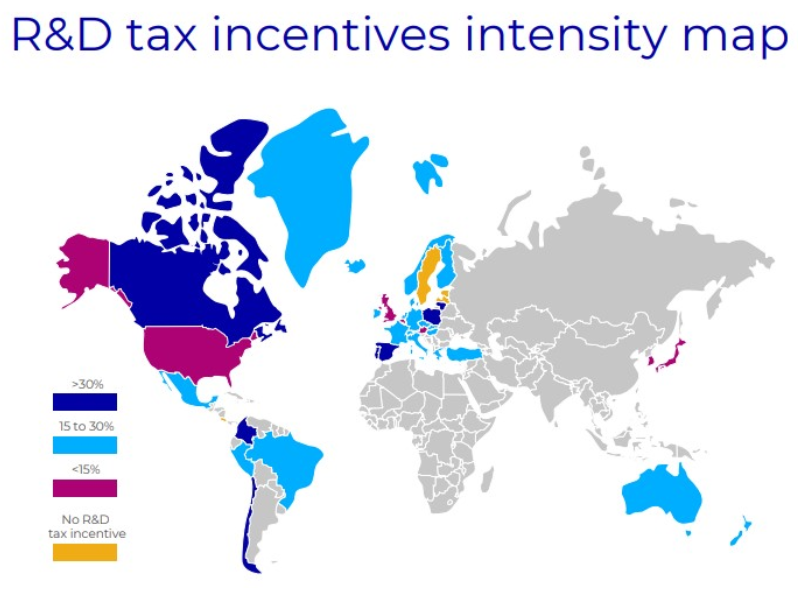
For this map to be representative of the different nature of R&D tax incentives (volume- based and incremental tax credits, super deduction), we took the scenario of a large company with R&D expenses during the last 10 years. Every year the amount of eligible R&D expenses is growing, as such, the claimant can apply for incremental R&D tax credits and deductions. The effective return on the R&D expenses is shown in the legend as a percentage of posttax reduction.
At FI Group we have extensive knowledge and experience in obtaining these tax incentives on different continents, with a global and coordinated strategy that is also complemented by the management and obtaining of public aid and subsidies for different types of investments. The combination of both incentives, from a strategic point of view and from a financial point of view, can mean for the company an important differentiation and competitive advantage within its scope of action.
FI Group has over 20 years of experience. Our specialized experts are at your disposal to analyze the fit of your project and advise you on obtaining tax incentives. Contact us.
2023 will go down as the breakthrough year for ChatGPT due to the intuitive capabilities and wide scope of applications of the tool.
But where did it all start?
Created in 2015, OpenAI has notable founders such as Elon Musk and Sam Altman with the aim of integrating artificial intelligence into society for the benefit of humanity. Looking back on the last seven months, you can definitely say their work has impacted society through their creation of ChatGPT.
In a nutshell, ChatGPT is an AI application that has been ‘trained’ to understand natural language and conversation. Pulling data from the internet and presenting its findings in easy to understand responses. Furthermore, it can be used as a translator, create content, summarise text and process / write code.
Ironically, you can find out about the R&D behind ChatGPT by simply asking it. The tool identifies five components that make up its development:
However, it can be difficult to put all this development into perspective and understand the gravity of its intelligence. The English language is comprised of one million words. In comparison, ChatGPT is made up of ten billion words, including fifteen languages (incl. English, French, Russian, Chinese, Arabic and Urdu), and sixteen programming languages (incl. Python, Java, JavaScript, C++ and, HTML/CSS).
If you wanted to dive deeper into the development of the tool, tokenization is the breaking down of the sequence of text into smaller units, appropriately called tokens. These help ChatGPT’s natural language processing (NLP) for further development.
As previously mentioned, OpenAI reached their goal of impacting society through their work. The applications for ChatGPT are vast, content creation, consultancy, and customer support to name a few.
A popular term being used more and more within industries is, ‘ChatGPT won’t take people’s jobs, people that use it will’. Which to an extent is correct. If utilised correctly by competent professionals with in-depth knowledge of their profession, then ChatGPT can allow for streamlined workflows and increased productivity.
Despite having ten billion words, mistakes can still be made. Users who copy and paste its responses risk not only incorporating the errors the tool might have created but also limiting themselves by hindering personal development in their respective careers.
FI Group has made the decision to move away from ChatGPT. At a glance this decision might undermine what was said previously about streamlining workflows, however, we have opted to use a different tool. We are launching MarIA which uses AzureGPT functions. Similar to ChatGPT, but can ensure that conversations and data shared with it remain in the Azure environment which provides an additional level of security.
On the topic of ChatGPT, FI Group France Scientific Director Charlie Grosman said:
‘while it generates useful and relevant information, in a short period of time, it is not a technology that employees should trust at an exact level».
What does MarIA mean for our clients?
FI Group requires a lot of sensitive information from our clients such as confidential R&D project details and employee salary, if this information is shared with ChatGPT it is then stored in OpenAI’s database and outside of our control. MarIA ensures that any private information is kept safe in our own database and cannot be accessed by anyone outside of FI Group.
Moreover, MarIA will also limit how much FI Group employees can use its functions. Ensuring that work is being done by real people and aided by the tool, when necessary, rather than the other way round. Meaning, clients can be assured they are getting genuine expert client opinions.
Given the great volumes of data and information to be handled these days, companies need to implement security measures and processes to guarantee data protection and privacy.
In the IT world, companies are becoming increasingly vulnerable to possible cyberattacks. It is therefore crucial for all organizations to have information security systems enabling them to analyse and detect possible anomalies that could indicate a potential threat to their servers.
Which is why we at the FI Group have an information security management system (ISMS) to guarantee the confidentiality and protection of internal information and our clients’ data. And in this respect, we have also been awarded the ISO 27001 certification again.
This certification demonstrates our commitment to providing high-quality products/services while adhering to strict international standards. We’re proud to have achieved its renewal, which recognizes the quality and strength of the FI Group’s ISMS.
Information security management systems are made up of policies, organizational structures, procedures, processes and resources necessary to guarantee the confidentiality, integrity and availability of information in an organization.
For some years now, leading international standardization bodies have been establishing requirements for the implementation of information security management systems. One of the most frequently used among them is the 27001:2017 standard by the International Organization for Standardization (ISO) because it is widely recognized internationally and permits implemented information security management systems to be certified.
We have implemented security measures and processes in several FI Group countries to ensure that all our systems are safe, and to demonstrate our commitment to customers. The countries already certified are:
– Belgium
– Brazil
– Canada
– Chile
– Colombia
– France
– Portugal
– Spain
– USA
– United Kingdom
– Germany
– Italy
Spain additionally has an ISO 27701certificate demonstrating an even higher level of privacy and data protection.
The renewal process has two major parts and takes a whole year.
The first part is an internal audit where all the ISO domains are evaluated, and we can verify the strength of the controls implemented in the company.
Once the internal audit has been completed, we focus on the aspects identified as potential improvement areas while working on the continuous development of our information security management system.
This process takes a whole year because it needs to continuously update and develop the implemented controls while adding new checks and processes that help to strengthen our company.
The second major part in October is the external audit where the company’s compliance with the controls and domains required by ISO 27001 is evaluated.
Once this audit is done, the country in question will either be certified again, unless of course it has failed to pass it.
We can see an improvement in our company’s processes and safer procedures that allow us to work with our own and customer information while maintaining the highest security standards.
The difference after implementing the certification is most tangible in our company’s day-to-day business and the confidence that we are working with truly private and confidential data.
Innovation and technological development lie at the core of FI Group’s DNA, filtering down through every member of the group. These elements are deemed indispensable for fostering growth and bolstering the competitiveness of any country.
This stemmed from the aftermath of the Covid-19 pandemic. Where both national and international policies strategically pivoted towards promoting investment in R&D&I and energy efficiency to reignite various sector’s work after the pandemic.
Regional, national, and European grants emerged as the primary public tools to drive economic revitalisation and foster growth across continents. Adequate public funding plays a pivotal role in facilitating the execution of large-scale R&D projects, which are critical for addressing the challenges posed by the prevailing political and economic landscape. These grants not only present opportunities for entities to confront these challenges but also serve as catalysts, inspiring innovation, differentiation, and investment to ensure development.
Currently, the continent boasts over 100,000 funding opportunities, encompassing regional, national, and European grants. Recognising the significance of these public funding opportunities, we have assembled a panel of experts from different countries to engage in a comprehensive discussion on the subject.
Among those attending this round table were:

1. First question: How many calls are there in each of your countries?
«Just imagine, according to the Spanish national database, in 2022 there were 62,817 calls for proposals,» –AV.
«At the regional level alone in this 2023, 459 calls have already been opened» –NZ.
«And we are only in May, we still have more than half the year ahead of us»- FAC to which Roberta explains that in Italy right now there are more than 650 published and waiting for the publication of another 97.
2. What do the calls for proposals mean for the different companies?
«I think we all agree that these calls for proposals, at all levels and for all types of companies, mean the possibility of making an investment or starting a project that would otherwise be difficult to carry out,» –VO.
«I totally agree. In addition to the fact that it makes it possible to grow the business and expand into new markets, and even to become known as a key player in the different sectors, especially in R&D calls,» –RD
«We cannot forget that it has an incentive effect, and that it also makes it possible to achieve results in a shorter period of time than would be possible without these calls». – AV
3. What role does FI Group play in the achievement of these objectives? How can we accompany the different companies in these processes of application to the different calls?
«At the level of the processes of fitting into the calls, application, monitoring and justification; for a company it is a tremendously bureaucratic and complex process. Being able to count on a trusted partner with years of experience is essential,» –AV *while her colleagues nod in agreement.
«With the support of a specialised agent or one that is close to the convening agency is a «privilege» that few actors have in this ecosystem. FI Group has a long experience and great success in all the stages that my colleague explained earlier,» -FAC
«We have teams of experts in both technical and financial areas, without forgetting that we are part of the ecosystem and know all the parties involved, being active and proactive in creating value propositions to improve the systems and funds so that they are more attractive and competitive,» –MO
«We also help to involve one or more stakeholders in relation to the sector or area, and we help and accompany them to improve collaboration. This is precisely due to a large global database of contacts that we have been working on during the 20 years of FI Group’s existence, which allows us to support our clients in an aggregated way, both at multi-country, multi-sector and multi-service levels».-RD
«Absolutely. To a great extent to the experience acquired, the knowledge, the connection networks, we have the capacity to offer this multi-country, multi-sector and multi-service service, but we also continue to do it as the first day, with an individual team per client, with an exclusive and close accompaniment, always making their project ours» –NZ
4. What are the most strategic sectors right now?
«I think we all agree that currently the most strategic sectors, not only for FI Group but for the whole of Europe and therefore for our clients, are industry in general and specifically all the electro-intensive ones, as well as everything related to energy, decarbonisation and hydrogen,» –NZ
«Automotive, ICT, Tourism, biotechnology, textile, chemical…». – MO
«From FI Group we continue and will continue to accompany all companies in achieving their objectives and their R&D&i projects, solving their doubts, finding the best fit in consortia or accompanying them in the justifications of the calls they have already achieved. This is and will be the driving force of all the colleagues who are part of this company». –VO
Hit the links below to access their LinkedIn profiles:
Case studies have argued that 50% of employees could be replaced by machines because of the big technological advancements in AI in the era of Digital Transformation, however, we see this as a complement instead as a negative human replacement.
We see computer software’s and AI as an addition to our activities, working alongside people who are part of the chain of vision. People can improvise, be reactive and think critically, showcasing the advantage of people in unexpected situations. There is a clear link between the collaborative work that can be done by AI and people, rather than a separation.
Knowing how to be an efficient and productive team is always the main aim of any successful partnership. As discussed, both people and AI have different strengths and weaknesses. By delegating tasks based on these strengths and weaknesses the digital transformation and partnership between people and AI can become more efficient and impactful.
It is becoming harder and harder to talk about Consultancy without mentioning digitisation. The digitisation of consultant tasks can be eased by Robotic Process Automation (RPA) software’s. These systems are designed to emulate human’s actions when interacting with digital systems, such as recognising and extracting relevant data.
This automation undoubtedly contributes to the streamlining of the consulting process. It can gather information immediately, transfer documents instantly, create news queries in a few minutes, solve the incidences quickly and in the stages of verifying or making changes to procedures.
So, the digital transformation allows for flexibility within automation systems, which develops ease and efficiently, making the consultants project writing time shorter. This is also a benefit for the client as it allows for quicker turn around time on R&D reports.
Focusing on the improvement of the value add of our services has always been one of our greatest priorities. Innovation and technology are core pillars of our business, we are always looking for ways to improve our internal procedures through digital advancements that are being made, to provide the best and most efficient results for our clients.
We offer a free audit to highlight and show our clients areas in their R&D process that can be improved by our team and service.
To improve this process, we have created an application that have improved the line of communication between FI Group and clients, and allows 24h access to updated claim information, improving our traditional services through new digital tools.
Introducing FI Connect. A new digital space that integrates several applications on a single platform. Benefiting our customers by providing greater transparency and showcasing the digital transformation that FI Group is currently undergoing and that will drive productivity for clients and consultants alike.
Find out if the service is available in your country to book a demo:
The pandemic has led to a global economic and social crisis, and the European Union and Member States have had to adopt emergency measures. Among these, the creation of an exceptional temporary recovery instrument, the NextGenerationEU, has been agreed.
FI Group is an active player in multiple European countries that will benefits from NextGenerationEU. These countries include:
FI Group has already developed a dedicated up and running Next Generation team in each of the countries listed. These teams are qualified to handle any questions or requirements your company might have regarding NextGenerationEU.
This recovery instrument is supported by 750 billion euros, part of which will be provided in the form of repayable loans (360 billion euros) and part of which will be provided in the form of non-repayable transfers (390 billion euros).
The EUR 750 billion will be distributed through different tools:
At FI Group we are supporting the entire value chain (startups, SMEs, large companies, knowledge centres, etc.) in areas such as:
If you want to find out more about how your company could benefit, get in contact with our team today!